Blog
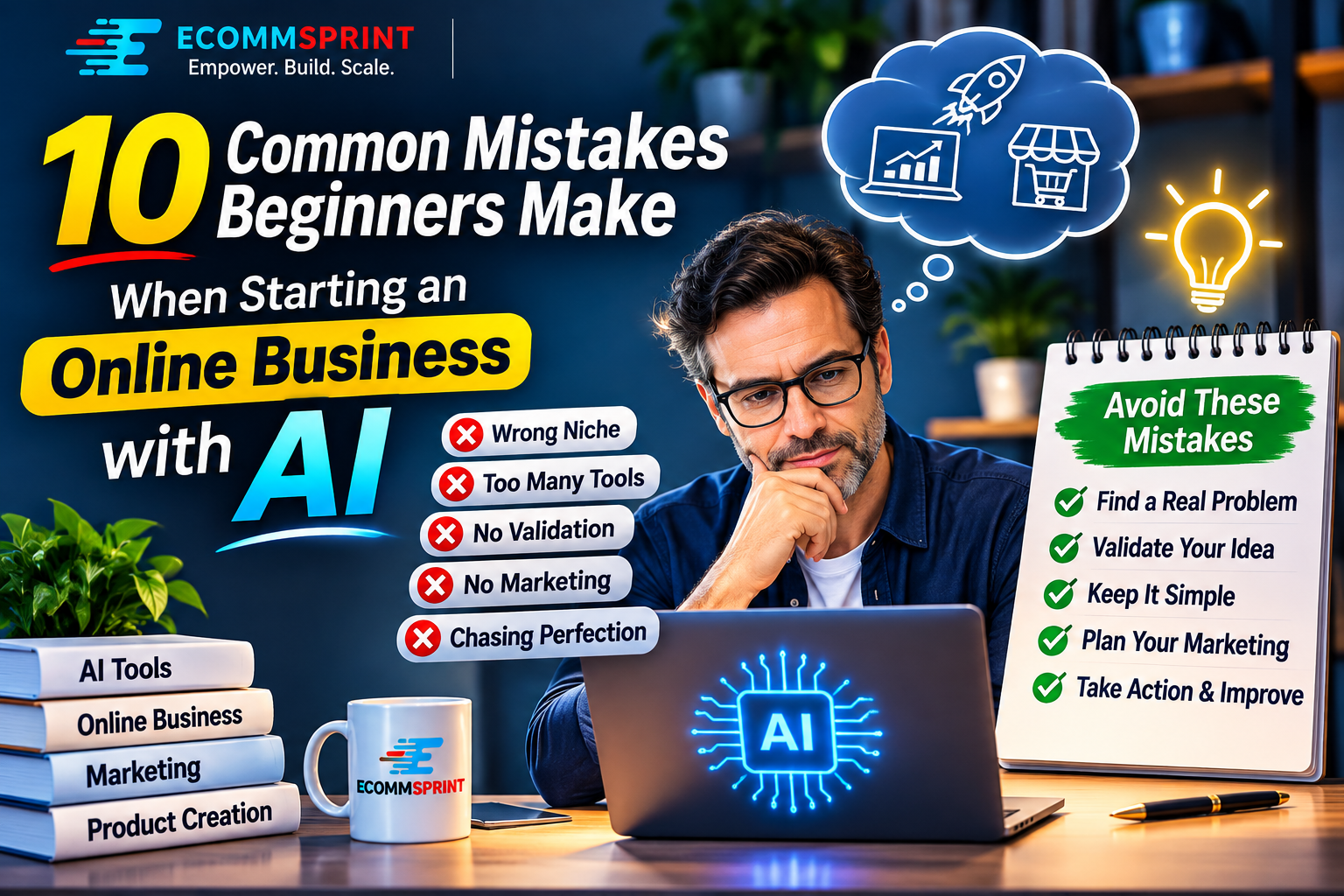
10 Common Mistakes Beginners Make When Starting an Online Business with AI

Starting an online business with AI sounds exciting. You can brainstorm ideas, write content, organize tasks, and explore business opportunities without needing a large team.
But there is a catch.
AI can make certain tasks faster, but it cannot guarantee that your business idea will work. A polished website, an impressive logo, and a collection of AI tools are not the same as having customers.
Many beginners make avoidable mistakes because they focus on technology before understanding the business itself.
In this guide, we’ll explore 10 common online business with AI mistakes, why they happen, and what you can do differently.
The goal isn’t to build a perfect business overnight. It’s to make smarter decisions, avoid unnecessary expenses, and give your idea a fair chance.
1. Starting with AI Tools Instead of a Real Customer Problem
One of the biggest mistakes beginners make is choosing an AI tool first and then trying to invent a business around it.
A better approach is to identify a problem people actually want solved.
For example, instead of deciding to sell AI-generated social media posts to everyone, consider helping a specific group, such as independent fitness coaches who struggle to plan their weekly content.
What to do instead:
- Choose a clearly defined audience.
- Identify one recurring problem they face.
- Talk to potential customers or study their existing complaints.
- Explore how AI might help you deliver a practical solution.
Quick action: Write down three problems your chosen audience experiences regularly. Pick one to investigate before building anything.
2. Assuming AI Research Proves Market Demand
AI is helpful for generating business ideas and organizing research. However, an AI-generated market analysis is not proof that customers are willing to pay.
A chatbot might describe an idea as promising without having access to recent sales figures or reliable customer feedback.
That is why independent validation matters.
The U.S. Small Business Administration’s business planning resources offer useful guidance on market research, competition, business planning, and startup costs.
What to do instead:
Use AI to develop research questions, then check those questions against real sources.
Look at competing products, customer reviews, public discussions, and available market data. Where possible, ask potential customers what they currently use and what they would like improved.
Quick action: Find three existing products serving your intended audience. Compare their features, prices, and customer feedback.
3. Buying Too Many AI Tools Before Making a Sale
It is easy to get carried away with software.
One tool promises better writing. Another offers automation. A third creates images. Before long, you’re managing subscriptions instead of building a business.
More tools do not automatically mean better results.
What to do instead:
Start with a small set of tools that supports your immediate needs:
- One AI assistant for brainstorming and drafting.
- One simple tool for creating your product.
- One platform for selling and delivering it.
- One method for tracking customers and results.
Add new software only when you can explain exactly what problem it solves.
Quick action: Review your current tools. Identify anything you’re paying for but not actively using.
Your goal is to complete a useful product, not collect software.
4. Trying to Serve Everyone
A business that targets everyone often struggles to communicate why anyone should buy.
Consider these two offers:
“AI resources for businesses.”
“Simple AI content-planning templates for independent fitness coaches.”
The second offer is easier to understand because it identifies a particular audience and a specific purpose.
That doesn’t guarantee demand, but it gives you a clearer starting point.
What to do instead:
Describe your audience, their problem, and your proposed solution in one sentence.
For example:
“I help beginner freelancers organize client projects using simple digital templates.”
Quick action: Complete this sentence:
“My product helps ______ solve ______ by providing ______.”
If you cannot explain your offer clearly, simplify it before spending money on advertising.
5. Publishing AI-Generated Content Without Checking It
AI can produce an impressive first draft in seconds.
Unfortunately, it can also produce inaccurate information, repetitive explanations, made-up references, and advice that sounds confident but lacks evidence.
Publishing that content without reviewing it can damage trust.
What to do instead:
Treat AI-generated material as a draft, not a finished product.
Check factual claims, remove repetition, rewrite awkward sentences, and add practical examples that make the content genuinely useful.
Always verify important financial, legal, technical, or business information using reliable sources.
Quick action: Review one page of your AI-assisted content. Remove anything you cannot explain, verify, or confidently stand behind.
A useful rule: AI can help you write faster, but you remain responsible for what you publish.
6. Spending Too Much Time Making Everything Perfect
Your website does not need twenty pages before you can test an idea.
Your first product does not need dozens of advanced features.
And your logo probably doesn’t need another fourteen revisions.
Perfectionism can become an expensive form of procrastination.
What to do instead:
Create a small, complete version of your offer that delivers a clear benefit.
For example, rather than building an enormous business course, start with a focused workbook that helps beginners complete one specific task.
Make sure it is accurate, usable, and properly presented. Then gather feedback and improve it.
Quick action: Write down the three essential things your product must do for the customer. Focus on those before adding extras.
7. Forgetting About Marketing Until the Product Is Finished
Some beginners spend weeks creating a product and only begin thinking about customers after publishing it.
Then comes the uncomfortable question: “Where is everyone?”
A good product still needs a practical way to reach potential buyers.
What to do instead:
Plan basic marketing while developing your offer.
You might publish helpful articles, create Pinterest content, build an email list with permission, or participate in relevant online communities.
For a step-by-step introduction, explore EcommSprint’s AI Business Starter Kit, which provides beginner-friendly guidance and practical exercises for organizing online business ideas.
Quick action: Choose one marketing channel that suits your target audience. Create three useful content ideas around problems your product helps solve.
Avoid trying to master every social platform at once.
8. Using Automation Before Understanding the Process
Automation is powerful when it supports a process that already works.
But automating a confusing or ineffective process simply creates problems faster.
Imagine automatically sending customers unclear onboarding instructions. Instead of saving time, you may create more support requests.
What to do instead:
Complete the process manually at least a few times.
Document each step, identify recurring tasks, and then decide what can be automated safely.
For example, once you understand how customers receive your digital products, you can explore automating routine delivery notifications and follow-up messages.
Quick action: Write out your customer journey, from discovering your product to receiving it. Circle repetitive steps that might benefit from automation.
Remember: automate the routine work, not the judgment your business still needs.
9. Ignoring Costs, Customer Experience, and Basic Business Rules
A business can receive orders and still struggle financially.
Beginners sometimes overlook payment processing fees, software subscriptions, advertising costs, refunds, and the time required to support customers.
They may also forget about privacy, intellectual property, consumer protection, and tax responsibilities.
What to do instead:
Keep a simple record of business expenses and revenue.
Before selling, make sure customers can understand what they are buying, how they receive it, how to contact you, and which refund terms apply.
For additional startup guidance, review the U.S. Small Business Administration’s planning guide.
Quick action: Create a basic expense list and a one-page customer support checklist.
A smaller, well-organized business is often easier to manage than a complicated one with unnecessary monthly costs.
10. Expecting AI to Generate Instant Income
This may be the most important mistake of all.
AI can help with research, drafting, design, organization, and certain repetitive tasks. It cannot create genuine customer demand by itself.
Online businesses still depend on useful offers, clear communication, customer trust, and consistent improvement.
Some ideas will fail. Others will need revisions. And many take longer to develop than expected.
What to do instead:
Set practical goals that you can control.
Rather than demanding a specific income in your first week, focus on:
- Completing and publishing one useful product.
- Getting feedback from potential customers.
- Testing one marketing channel.
- Tracking visits, inquiries, and actual sales.
- Improving your offer based on evidence.
Quick action: Choose one measurable goal for the next seven days that does not depend entirely on making a sale.
Progress is easier to manage when you measure useful actions as well as outcomes.
A Simple 7-Day Action Plan to Avoid These Mistakes
You do not need to fix everything at once. Use this practical plan to build a more focused starting point.
| Day | Your Action |
|---|---|
| Day 1 | Choose one audience and identify a problem |
| Day 2 | Research competing solutions and customer needs |
| Day 3 | Define one simple product or service |
| Day 4 | Select only the essential AI tools |
| Day 5 | Create and review a small, usable offer |
| Day 6 | Prepare a clear product page and one marketing channel |
| Day 7 | Share your offer appropriately, collect feedback, and plan improvements |
You can adapt the schedule to your available time. The important part is completing meaningful steps rather than rushing through them.
Final Thoughts: Build Smarter, Not Just Faster
Avoiding these online business with AI mistakes will not guarantee success, but it can help you make more informed decisions.
Start with a real problem. Research your audience. Build something useful. Check your AI-generated work. Keep expenses under control and improve your offer based on what you learn.
AI works best as a practical assistant, not as a substitute for business judgment.
Your next step: Choose one mistake from this article that applies to your current project and take one small action to address it today.
You do not need to have every answer before getting started. You need a sensible direction, reliable information, and a willingness to learn.
Keep Learning with EcommSprint
EcommSprint creates practical digital guides, workbooks, templates, and AI-related resources for beginners exploring online business.
Visit the EcommSprint website to discover additional learning resources, or explore our AI Business Starter Kit for practical guidance on organizing your next steps.
Disclaimer: This article is for general educational purposes only. It does not provide financial, legal, or tax advice. Results depend on individual circumstances, market conditions, and execution. No income or business success is guaranteed.
One thought on “10 Common Mistakes Beginners Make When Starting an Online Business with AI”
Comments are closed.